
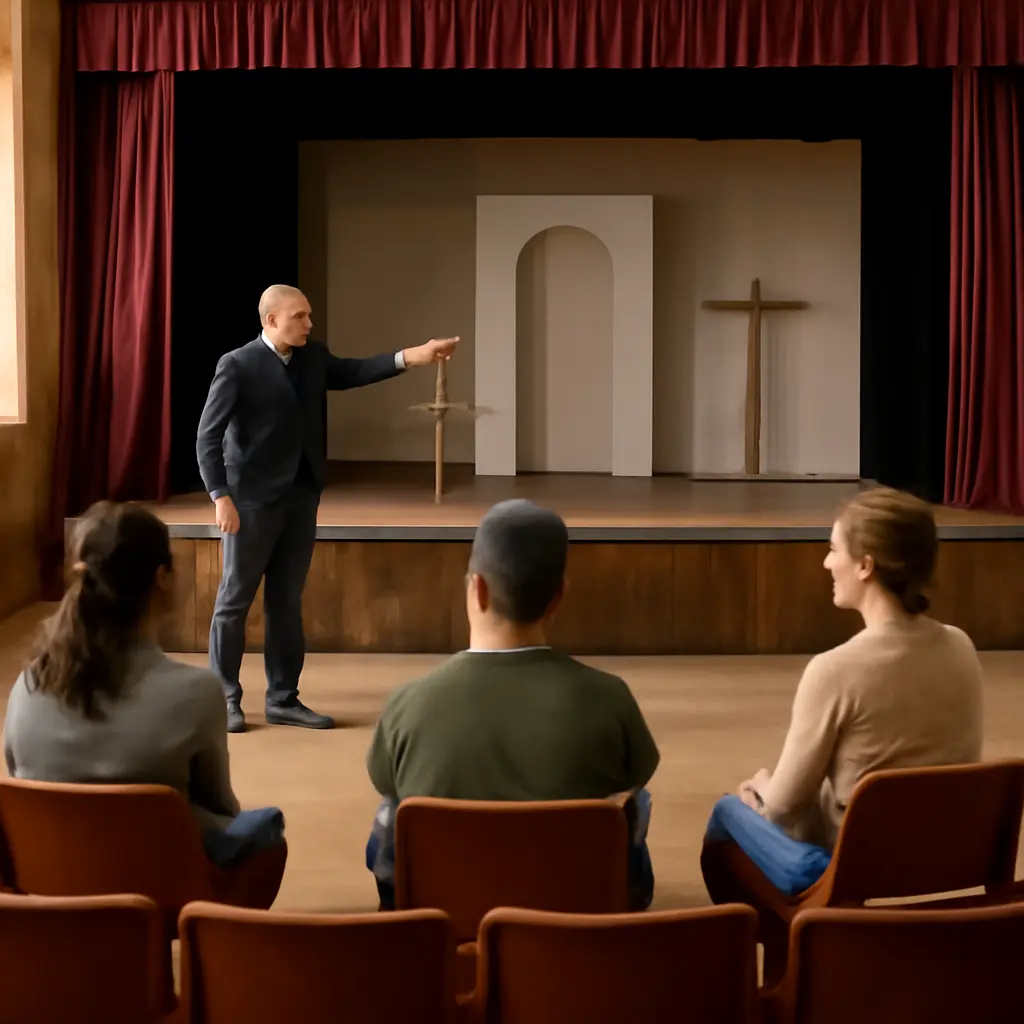
Theatre’s spiritual power is its capacity to make shared beliefs, moral questions, grief, and hope tangible through live performance. From medieval Passion plays depicting Christ’s suffering to contemporary dramas that explore faith, identity, and social responsibility, theatre has repeatedly turned spiritual ideas into communal experience. This history matters beyond the stage: UNESCO recognizes theatre as part of living cultural heritage, while the National Endowment for the Arts’ 2022 Survey of Public Participation in the Arts found that 48 percent of U.S. adults attended at least one arts event in person during the preceding year. The evidence is not a direct measure of theatre’s spiritual effects, but it underscores the continuing public setting in which performance can invite reflection. The story runs from ritual and medieval devotion through modern drama to today’s diverse, often secular forms of spiritual inquiry.
Passion plays shaped theatre’s spiritual power
A Passion play is a dramatic presentation of Jesus Christ’s suffering and death, usually drawing on the Gospel narratives. Theatre historian John R. Elliott Jr., in Playing God: Medieval Mysteries on the Modern Stage, describes the medieval mystery-play tradition as a cycle of biblical dramas performed by civic communities. These works did more than retell scripture: they made sacred history visible to audiences through bodies, speech, music, and public space.
Passion plays belonged to a wider family of religious drama, including mystery plays based on biblical history, miracle plays about saints, and morality plays that dramatized ethical choices through allegorical characters. Their spiritual influence came partly from this close connection between belief and participation: performers and spectators gathered as a community, and the story’s moral and emotional stakes were enacted rather than merely explained.
Medieval mystery cycles made sacred stories communal
Mystery cycles presented episodes from the Bible, sometimes ranging from Creation to the Last Judgment. In English towns such as York and Chester, local craft guilds organized and performed pageants, linking religious storytelling with civic life. The York cycle is commonly understood to have contained 48 plays, although the surviving text is incomplete. Its pageants moved through public streets, turning the town itself into a sequence of theatrical locations.
The form’s defining feature was embodied interpretation: a performer’s voice and gesture made a distant sacred event immediate. This shared encounter could prompt devotion, sympathy, or moral debate. It also explains why medieval religious drama should not be treated simply as an early version of modern theatre; it served worship, instruction, entertainment, and civic identity at once.
The Oberammergau Passion Play sustains a living tradition
The Oberammergau Passion Play in Bavaria illustrates how a religious performance can become a recurring community institution. Residents trace its origin to a vow made during a 1633 plague outbreak, and the village has generally staged the production once each decade since 1634, with historical interruptions. The 2022 edition involved hundreds of local participants and drew audiences over a season of performances, according to the organizers.
The play’s history also shows that spiritual performance exists within changing social and ethical expectations. Its staging and language have been revised over time, including efforts to address antisemitic elements inherited from earlier Christian Passion traditions. The example connects medieval communal drama to a modern question: how can a sacred story remain powerful while being presented responsibly to contemporary audiences?
Modern drama transformed spiritual inquiry
Modern drama widened theatre’s spiritual range. Rather than focusing only on biblical narrative, playwrights examined doubt, mortality, conscience, social injustice, and the search for meaning. The shift did not remove religion from theatre; it made belief itself a subject of dramatic conflict. This movement from inherited doctrine to personal and social questions can be seen in realist drama, modernist experimentation, and politically engaged theatre.
Realism brought ethical and spiritual conflict into ordinary life
Realist drama represents recognizable people and social conditions, often using domestic settings to expose hidden conflicts. Henrik Ibsen’s Brand and Ghosts, for example, probe religious authority, moral responsibility, and the consequences of inherited beliefs. In Anton Chekhov’s plays, spiritual questions often emerge less as sermons than as uncertainty, loneliness, and the longing for a more meaningful life.
This approach changed the audience’s role. Viewers were asked to judge competing claims and interpret ambiguous motives rather than receive a single moral lesson. The stage became a place where spiritual and ethical questions could be examined through ordinary relationships, making private choices part of a broader social conversation.
Modernist theatre made uncertainty a dramatic form
Modernist and absurdist theatre often conveys spiritual disorientation through fractured plots, repetition, silence, and sparse settings. Samuel Beckett’s Waiting for Godot famously places two characters in an uncertain world as they wait for someone who may never arrive. The play’s ambiguity invites religious interpretations, but it does not require one: its force also comes from the human need to hope and make meaning amid uncertainty.
This formal experimentation is a key hyponym of modern spiritual drama: theatre of existential searching. It differs from the direct devotional purpose of a Passion play, yet shares an interest in mortality, redemption, suffering, and the limits of human understanding. Its open-ended structure lets audiences bring different beliefs to the same performance.
Political theatre linked moral conviction with public action
Political theatre treats social arrangements as matters of conscience. In the work of Bertolt Brecht, theatrical techniques such as direct address and visible stagecraft encouraged audiences to analyze events rather than simply lose themselves in a story. Later, Augusto Boal’s Theatre of the Oppressed developed participatory methods in which spectators could intervene in scenes of oppression and test possible responses.
These practices connect spiritual power with justice and responsibility. They need not use religious language to raise questions traditionally associated with spiritual life: What do people owe one another? How should communities respond to harm? What kind of change is possible? The bridge from modernist introspection to political theatre is the move from personal meaning toward collective responsibility.
Contemporary theatre renews ritual and shared reflection
Contemporary theatre draws on religious ritual, cultural memory, personal testimony, and secular forms of contemplation. Its spiritual power is not confined to plays about gods or organized religion. A performance may create a temporary community through attention, silence, music, and shared emotional response, while also challenging audiences to consider whose stories are heard and whose traditions are represented.
Documentary and community theatre turn lived experience into testimony
Documentary theatre builds performance from interviews, records, and other real-world material; community theatre places local participants and concerns at the center of the work. Both can function as public acts of witnessing. When people encounter testimony about migration, violence, illness, or loss in a live setting, the theatrical event can encourage empathy and deliberation without claiming that one performance resolves the underlying issue.
The National Endowment for the Arts’ 2022 participation survey provides a useful measure of the broader cultural context: 48 percent of U.S. adults attended an in-person arts event during the prior year, while participation varied by art form and population. These figures describe arts attendance, not theatre’s spiritual impact, but they help show why live performance remains a meaningful channel for public encounter.
Intercultural performance raises questions of belonging
Intercultural theatre brings together artistic traditions, languages, or performance conventions from different communities. When handled with research and collaboration, it can make cultural exchange visible and deepen understanding of distinct spiritual practices. When traditions are borrowed without context or consent, however, the result can be appropriation rather than dialogue.
UNESCO’s Convention for the Safeguarding of the Intangible Cultural Heritage defines living heritage to include practices, expressions, knowledge, and skills that communities recognize as part of their cultural heritage. That framework helps explain why sacred performance traditions should be understood as living practices, not merely as material for artistic quotation. In theatre, respectful exchange depends on credit, consultation, and attention to the people who sustain a tradition.
Audience participation can restore theatre’s ritual dimension
Participatory theatre invites audience members to speak, move, make choices, or otherwise influence the performance. Its methods range from post-show discussion to interactive productions and Boal-inspired forum theatre. Participation does not automatically produce spiritual transformation, but it can shift spectators from passive observation to shared responsibility and reflection.
A practical way to assess this work is to ask what the performance makes possible: Does it create attentive listening? Does it offer space for disagreement? Are participants treated with care? These questions connect theatrical form to its ethical effects and distinguish genuine engagement from interaction added merely for novelty.
Conclusion: Theatre’s spiritual power remains a shared practice
From medieval mystery cycles and the Oberammergau Passion Play to realist, modernist, political, documentary, and participatory drama, theatre has repeatedly made spiritual questions public and embodied. Its forms have changed—from explicit biblical storytelling to open-ended explorations of doubt and justice—but its central capacity remains: people gather to witness a story, interpret it together, and consider what it asks of them.
Theatre’s spiritual power should not be measured only by attendance or by whether a production expresses religious belief. It also lies in its ability to foster attention, preserve cultural memory, and invite ethical imagination. Readers can explore local theatre, learn the histories behind performance traditions, and support productions that approach spiritual and cultural material with rigor and respect.
Sources: John R. Elliott Jr., Playing God: Medieval Mysteries on the Modern Stage, University of Toronto Press, 1989, https://utorontopress.com/; York Mystery Plays, “The York Mystery Plays,” https://yorkmysteryplays.co.uk/; Passion Play Oberammergau, “The Passion Play,” https://www.passionsspiele-oberammergau.de/en/; National Endowment for the Arts, “2022 Survey of Public Participation in the Arts,” https://www.arts.gov/impact/research/publications/2022-survey-public-participation-arts; UNESCO, “Convention for the Safeguarding of the Intangible Cultural Heritage,” https://ich.unesco.org/en/convention; Augusto Boal, Theatre of the Oppressed, Pluto Press, 1979, https://www.plutobooks.com/