
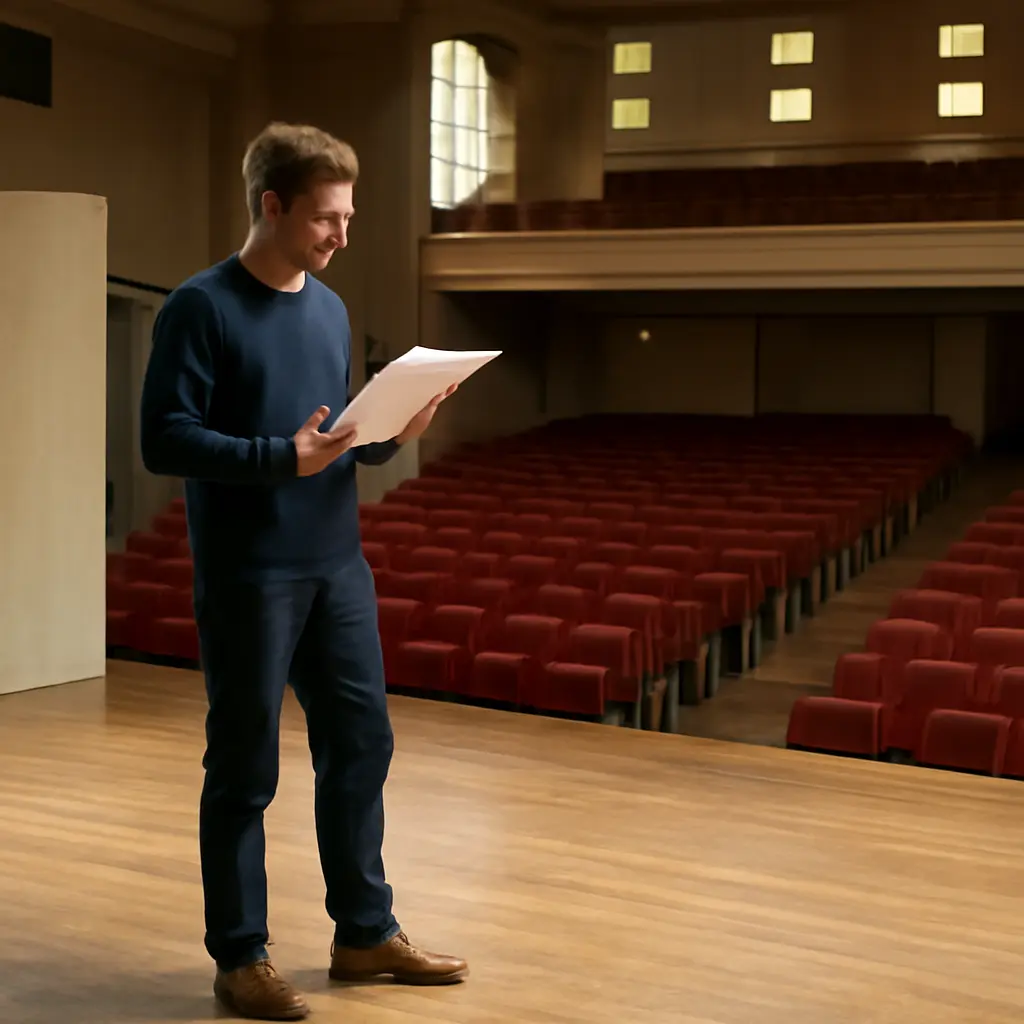
Stage drama is live theatrical storytelling: performers and audiences share the same place and time as a story unfolds. It keeps its place in collective memory because each performance combines a familiar text or tradition with the unrepeatable presence of actors and spectators. UNESCO’s recognition of theatre-related traditions as intangible cultural heritage, alongside the enduring revival of works such as Shakespeare’s plays, shows how performance can carry stories across generations. This article examines how shared presence, cultural transmission, adaptation, and public participation help stage drama remain memorable—and why those qualities matter in an age of recorded media.
Stage Drama’s Shared Presence and Collective Memory
Collective memory refers to the ways groups remember and interpret a shared past through stories, images, rituals, and public commemorations. In his work on social frameworks of memory, sociologist Maurice Halbwachs argued that people remember within social groups rather than in isolation. Stage drama gives those groups a live setting in which to revisit the past, test inherited meanings, and make a story relevant to the present.
Drama is not simply a script or a performance: it encompasses scripts, acting traditions, rehearsal practices, venues, and audience responses. The live encounter is central. Actors adjust their delivery to the room, spectators react together, and the same play can acquire different meanings in different periods. These qualities connect dramatic performance to oral storytelling, ritual, festivals, and public commemoration.
Liveness and shared attention
Liveness is the experience of performers and spectators sharing an event as it happens. Theatre scholar Erika Fischer-Lichte describes performance as an exchange in which performers’ actions and audience responses can affect one another. Laughter, silence, applause, or visible unease become part of the occasion, creating a common experience that audiences may later recall and discuss.
This does not mean that every spectator remembers a performance in the same way. Rather, a live event creates a shared reference point: people can say they witnessed the same production while interpreting its scenes differently. The Royal Shakespeare Company’s continuing productions of Shakespeare demonstrate how a common dramatic text can generate new conversations as casts, staging, and audiences change.
Theatre as intangible cultural heritage
Intangible cultural heritage includes practices, expressions, knowledge, and skills that communities recognize as part of their cultural inheritance. UNESCO’s 2003 Convention for the Safeguarding of the Intangible Cultural Heritage identifies performing arts among the domains of this heritage. The convention emphasizes that living traditions are transmitted between generations and continually recreated by communities, rather than preserved only as fixed objects.
UNESCO’s Representative List offers examples of performance traditions associated with community identity, including Japanese Noh theatre, Indonesian wayang puppet theatre, and the Indian tradition of Kutiyattam Sanskrit theatre. Their survival depends on more than written scripts: performers pass on specialized techniques, musical forms, conventions, and interpretations through practice. That transmission links theatrical memory to education and cultural stewardship.
Stage Drama Transmits Stories Across Generations
Transmission is the process by which stories and performance knowledge move between people and generations. In stage drama, it happens through scripts, repeated productions, teaching, rehearsal, and audience retelling. Unlike a monument that remains materially fixed, a play is renewed whenever people perform it; continuity and change therefore operate together.
Repertoire, revival, and historical memory
A theatrical repertoire is a body of plays and performance traditions that companies, schools, and communities return to over time. Revivals make historical texts available to new audiences, while directors and actors interpret them through contemporary concerns. Shakespeare’s history plays, for instance, have repeatedly been staged as arguments about authority, national identity, and political legitimacy—not merely as reconstructions of the past.
The same process can recover histories that were marginalized or excluded from dominant accounts. A production may place a familiar story in a new setting, cast it in ways that challenge inherited assumptions, or pair it with community testimony. Such choices do not erase the earlier play; they make its cultural memory visible as something contested and revisable.
Oral traditions and embodied knowledge
Embodied knowledge is understanding carried in trained movement, voice, gesture, rhythm, and technique. In performance traditions that rely on oral instruction or apprenticeship, learners absorb conventions by watching and practicing with experienced artists. This knowledge can preserve a community’s artistic vocabulary even when a performance is not recorded or a script is incomplete.
UNESCO’s description of Kutiyattam, for example, highlights its long training and highly codified acting conventions. The tradition demonstrates why safeguarding performance requires supporting practitioners and opportunities to perform—not only archiving texts. A living art form survives through the people who can enact and teach it.
Stage Drama Builds Social Memory Through Participation
Social memory is formed when people connect personal recollections to shared accounts of events and identity. Theatre can make that process public: an audience watches characters confront conflict, recognizes parts of its own experience, and considers how a community might interpret the same events. The result may be solidarity, disagreement, or both.
Audience response and communal interpretation
Audience participation does not require spectators to speak or enter the stage. Attention, emotion, and subsequent discussion are forms of engagement. The National Endowment for the Arts’ Survey of Public Participation in the Arts tracks attendance at live performances, including plays and musicals, as one measure of Americans’ engagement with the arts. Such surveys document participation, although attendance figures alone cannot prove how a performance changes memory or belief.
Theatre’s distinctive contribution is that spectators encounter a story together. A production about war, migration, injustice, or family history can prompt discussion between people who might otherwise experience those subjects privately. Post-show conversations, school performances, and community productions extend the event beyond the auditorium and help turn a performance into a shared point of reference.
Commemoration, protest, and public debate
Commemorative drama revisits people or events that a community considers significant, while protest theatre uses performance to question power or call attention to social problems. These forms make memory active: rather than simply recalling what happened, they ask what the past means now and what obligations it creates.
Theatre has long served as a forum for public debate, from ancient Greek tragedy’s engagement with civic questions to modern documentary theatre built from testimony and records. Its impact depends on context: a production can challenge dominant narratives, but it can also reinforce them. Reviewing who is represented, whose accounts are absent, and who has access to the stage is therefore essential to understanding its role in collective memory.
Stage Drama Adapts to New Media Without Losing Its Distinction
Adaptation allows theatrical stories to travel across eras, languages, and formats. Productions may reinterpret a classic, combine performance with digital projection, or make a recorded version available to viewers at a distance. These approaches expand access, but they do not reproduce every feature of the live encounter: a recording preserves a particular performance, while live theatre changes with each cast, audience, and occasion.
Reinterpretation keeps familiar stories meaningful
A reinterpretation gives an existing play or tradition a new frame. Changes in setting, language, design, or casting can reveal implications that earlier audiences overlooked. This is one reason canonical drama persists: a familiar story provides a common foundation, while each production can invite a new generation to question its values.
Adaptation also occurs when plays move between cultures. Translation and intercultural staging can introduce a work to new audiences, but responsible adaptation requires attention to the source tradition and the communities connected to it. When practitioners are involved in these decisions, adaptation can broaden memory without treating cultural heritage as a detached resource.
Digital access and the value of live performance
Digital recordings, livestreams, and online archives preserve performances and help audiences who cannot attend in person. They can support teaching, research, and the circulation of work beyond a theatre’s local reach. At the same time, a recording fixes one version of a production, whereas live performance remains contingent and responsive.
A useful way to compare these formats is to distinguish preservation from renewal. Archives help retain evidence of what was staged; live productions renew the practice by bringing performers and audiences together again. Both can contribute to cultural memory, but neither makes the other unnecessary.
Conclusion: Why Stage Drama Remains in Collective Memory
Stage drama endures in collective memory because it combines shared presence, intergenerational transmission, social participation, and creative adaptation. UNESCO’s heritage framework shows that performance traditions are sustained through communities and practitioners; scholarship on liveness explains how audiences and performers shape an event together; and public-participation research provides evidence that live arts remain part of contemporary cultural life. These factors make theatre both a record of inherited stories and a means of revisiting them.
To explore this subject further, attend a local production, compare different stagings of the same play, or learn about the performance traditions represented in UNESCO’s heritage lists. Supporting theatre companies, artists, and cultural education helps ensure that shared stories remain available for future generations to interpret.
Sources: Maurice Halbwachs, On Collective Memory, University of Chicago Press, 1992; Erika Fischer-Lichte, The Transformative Power of Performance: A New Aesthetics, Routledge, 2008; UNESCO, Convention for the Safeguarding of the Intangible Cultural Heritage, https://ich.unesco.org/en/convention; UNESCO, Representative List of the Intangible Cultural Heritage of Humanity, https://ich.unesco.org/en/lists; UNESCO, Nohgaku Theatre, https://ich.unesco.org/en/RL/nohgaku-theatre-00012; UNESCO, Wayang Puppet Theatre, https://ich.unesco.org/en/RL/wayang-puppet-theatre-00063; UNESCO, Kutiyattam, Sanskrit Theatre, https://ich.unesco.org/en/RL/kutiyattam-sanskrit-theatre-00010; National Endowment for the Arts, Survey of Public Participation in the Arts, https://www.arts.gov/impact/research/arts-data-profile-series/adp-29