
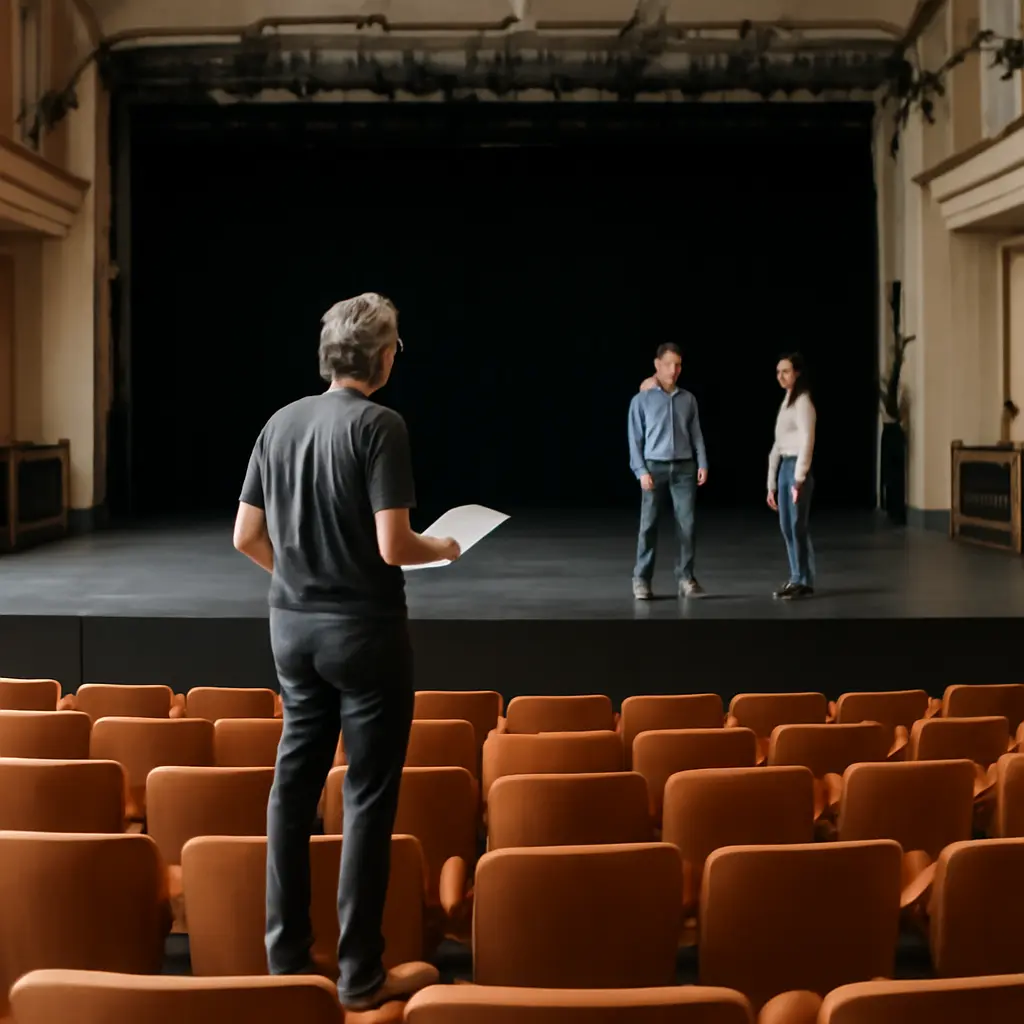
Stage blocking—the deliberate placement and movement of performers in a performance space—is a storytelling tool, not merely a way to keep actors from bumping into one another. Where performers stand, sit, cross, or turn can direct attention, reveal relationships, create tension, and clarify a scene’s meaning. A 1985 study by William J. Friedman found that viewers’ eye movements while watching theater were influenced by both the actors’ positions and their movements, underscoring how stage composition guides audience attention. From stage pictures and sightlines to proxemics and movement, thoughtful actor placement helps make a production readable, emotionally compelling, and accessible.
Stage Blocking Shapes the Audience’s Attention
Stage blocking is the planned arrangement and movement of performers within a performance space. The Stage Directors and Choreographers Society describes blocking as the physical business of a scene: where actors move and how they use the stage. Directors and performers use it to communicate information visually, alongside dialogue, lighting, sound, and design.
Placement matters because audiences do not give equal attention to every part of a stage at once. Friedman’s eye-movement research, published in Psychological Research, found that viewers’ gaze was affected by the actors’ locations and actions. A performer who moves, occupies a central position, or stands apart from a group may attract attention; that attention can be used to reveal a reaction, emphasize a power shift, or create suspense.
The core forms of blocking include stage pictures, sightline management, proxemics, levels, and motivated movement. Each serves a different purpose, but they work together: a director arranges a visual composition, checks that spectators can see it, and uses distance and movement to express the relationships within it.
Stage Pictures Establish the Scene’s Visual Meaning
A stage picture is the overall visual arrangement of performers at a particular moment. It includes their spacing, orientation, relative height, and relationship to set pieces. A balanced composition can suggest order or agreement; an isolated performer within a tightly grouped ensemble can suggest exclusion, vulnerability, or disagreement.
Directors often consider visual balance, contrast, and focus when shaping a stage picture. These are practical choices rather than fixed formulas: an asymmetrical arrangement may feel unstable, while a symmetrical one may imply formality or control. The intended meaning depends on the story, performance style, and design surrounding the actors.
Sightlines Keep Important Action Visible
Sightlines are the audience’s lines of view from their seats to the playing area. Blocking must account for them so that an actor’s face, a significant gesture, or an important stage object is not hidden behind another performer or scenic element. A composition that reads clearly from the center of the auditorium may be obscured from a side seat, so directors and stage managers commonly check scenes from multiple viewing positions.
Visibility is also a matter of emphasis. When a performer turns away, sits, or moves behind another actor, that choice can deliberately reduce their visual prominence. When the moment requires the audience to notice a reaction, an open angle or a position with a clear view of the face can make the information easier to read.
Stage Blocking Expresses Relationships Through Space
The placement of performers can make emotional and social relationships legible before anyone speaks. One useful concept is proxemics: the study of how people use interpersonal distance and space. Anthropologist Edward T. Hall introduced the term in The Hidden Dimension (1966), describing how spatial behavior carries social meaning. In performance, a gap between actors may signal distrust, while a character’s intrusion into another’s space can suggest intimacy, pressure, or threat.
These meanings are not universal. Cultural conventions, genre, character history, and the production’s visual language shape how audiences interpret distance and posture. Blocking is most effective when spatial choices are consistent with the scene’s circumstances, rather than applied as a simple code in which one distance always means the same thing.
Distance and Grouping Reveal Power
Proxemic blocking uses distance, grouping, and separation to show who feels connected, excluded, or in control. A character who remains physically apart from a group may appear to challenge it or be rejected by it. An actor who controls access to a chair, doorway, or central position can appear to hold authority, especially when others adjust their positions around them.
Consider a negotiation staged with one character seated at a desk while another must stand across from it. The furniture and distance can reinforce an imbalance before the dialogue confirms it. If the standing character later crosses behind the desk or pulls up a chair, the changed arrangement can mark a shift in confidence or status.
Levels and Orientation Shape Status
Levels refer to differences in performers’ heights and vertical positions, such as standing, sitting, kneeling, or appearing on a platform. Orientation describes the direction actors face in relation to one another and the audience. Together, these choices affect visibility and can suggest status, vulnerability, attention, or resistance.
A character standing above another may appear physically dominant, but the interpretation depends on context: a person seated while others stand might still command authority. A performer who turns toward the audience can make a thought or reaction more visible, while a turned back can communicate withdrawal or concealment. The meaning comes from the whole stage picture, not a single position in isolation.
Actor Movement Directs Focus and Builds Dramatic Rhythm
Movement gives blocking its sense of progression. A cross can redirect attention, mark a decision, or alter the balance between characters; a still moment can make the audience wait for a response. The key distinction is motivation: movement feels purposeful when it follows a character’s objective, changes the scene, or helps the audience understand what matters.
Research on theatrical spectatorship supports the importance of movement and position. Friedman’s study of eye movements found that audience gaze responds to performers’ spatial arrangements and actions. This does not mean that every movement automatically attracts attention, but it does highlight why directors plan crosses, pauses, and stillness as part of the scene’s visual storytelling.
Motivated Movement Makes Action Readable
Motivated movement is a physical action connected to a character’s intention or to a change in the scene. An actor might approach another person to persuade them, retreat to avoid a confrontation, or cross to a window after hearing a sound. When movement has a clear dramatic reason, it can reinforce the dialogue and help the audience follow the character’s thinking.
Unmotivated movement can dilute focus. If actors shift position without a clear purpose, the audience may attend to the motion instead of the important line or reaction. Directors and actors can test each move by asking what changes as a result: the relationship, the focus, the physical risk, or the character’s access to another person or object.
Stillness and Pauses Create Contrast
Stillness is an active blocking choice, not an absence of staging. When a performer remains motionless while others move, that contrast can make the still actor appear watchful, isolated, or emotionally overwhelmed. A pause in movement can also give a line or reaction room to register before the scene changes direction.
The effect depends on timing and context. A sustained pause may heighten suspense in a thriller, while a brief, awkward silence can sharpen a comedy. In either case, the director coordinates physical stillness with performance rhythm, lighting, sound, and the audience’s opportunity to see the actor’s expression.
Directors Test Blocking Against the Space and Audience
Blocking is shaped by the venue as well as the script. A proscenium theater, an arena, and a studio space offer different viewing angles and relationships between performers and spectators. The same arrangement may be clear from one seat and confusing from another, so rehearsal involves testing visibility, timing, and transitions in the actual performance space whenever possible.
Audience Configuration Changes the Composition
In a proscenium theater, most spectators face the stage from one general direction, making front-facing compositions and clear diagonals useful. In an arena, spectators surround the playing area, so performers and directors must consider multiple sightlines and avoid treating one side as the only audience. In a thrust stage, the audience views the action from three sides, making frequent adjustment of actor orientation especially important.
These differences affect practical choices. A face-to-face arrangement may work well in a proscenium house but leave some arena spectators looking at actors’ backs for long stretches. Directors can adapt by turning the exchange through the space, varying actor angles, or arranging the group so that the essential action remains visible across the audience.
A Blocking Pass Checks Clarity and Meaning
A simple review process can help turn staging choices into a coherent visual story:
- Identify the scene’s central conflict and the moments when the balance of power changes.
- Choose positions and distances that make those relationships visible.
- Check that key faces, gestures, and objects remain visible from different seats.
- Give each movement a clear dramatic or practical reason.
- Revisit the composition after adding scenery, costumes, lighting, and sound.
This process also supports accessibility. Clear stage pictures and visible reactions can help spectators follow the action, while productions may additionally use captioning, audio description, relaxed-performance adjustments, or other access measures tailored to their audiences. Blocking does not replace those services, but it is one part of making the action easier to perceive.
Conclusion: Actor Placement Is Part of the Story
Stage blocking shapes audience attention through stage pictures and sightlines, expresses relationships through proxemics and levels, and builds dramatic rhythm through motivated movement and stillness. Research on theater audiences, including William J. Friedman’s eye-movement study, supports the practical insight that performers’ positions and actions influence where spectators look. The broader lesson is that space is a storytelling resource: a deliberate distance, turn, or cross can communicate what dialogue leaves unsaid.
For actors, directors, and theater students, the next step is to watch a scene with its spatial choices in mind. Notice who occupies the center, who is left apart, which movements change the focus, and whether the action remains visible from different seats. Then experiment with one adjustment at a time and observe how it changes the scene’s meaning.
Sources: Stage Directors and Choreographers Society, “What Is a Stage Director?”, https://sdcweb.org/about-sdc/what-is-a-stage-director/; Friedman, William J., “The Effect of Actors’ Position and Movement on the Audience’s Visual Attention,” Psychological Research, 1985; Hall, Edward T., The Hidden Dimension, Doubleday, 1966.