
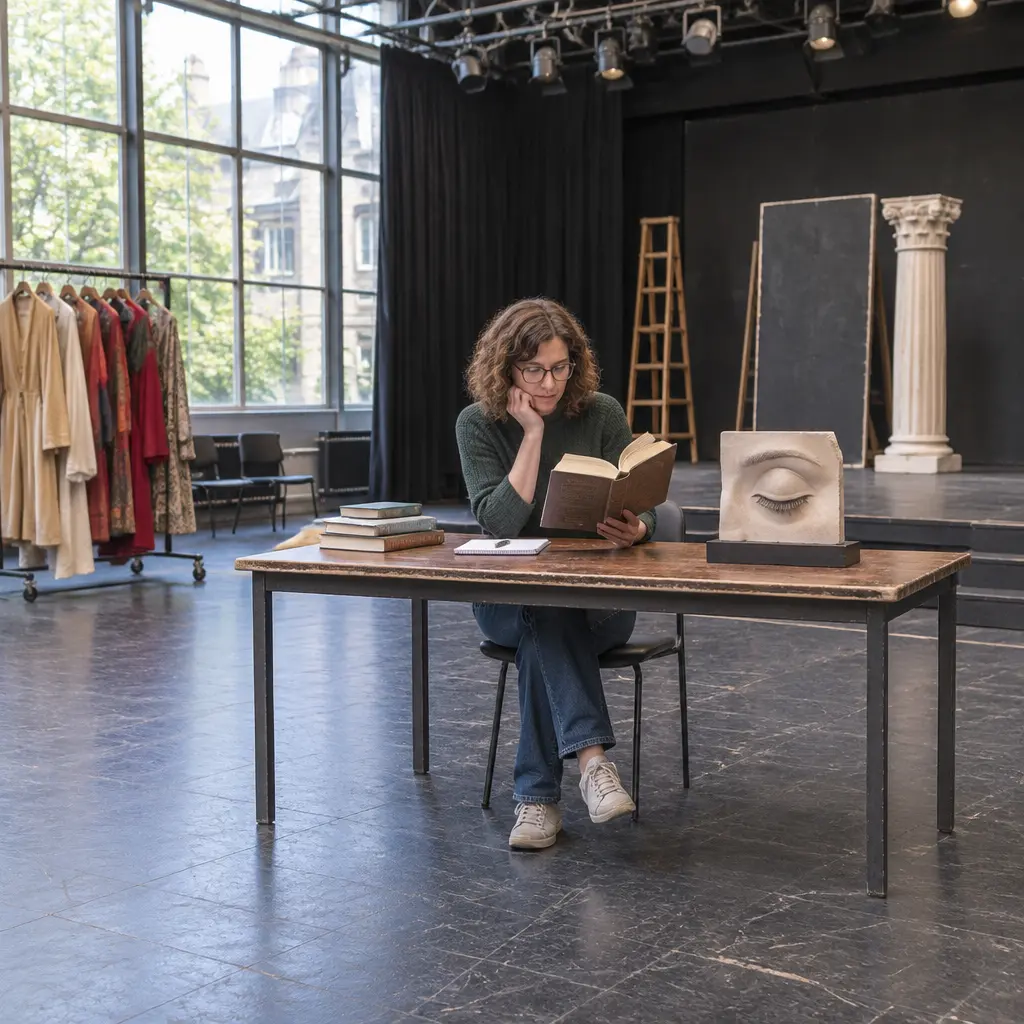
Dreams and visions in classical drama are theatrical representations of sleep, prophecy, divine revelation, or altered perception. In Greek and Roman tragedy and comedy, they can foreshadow events, expose hidden fears, authorize political or religious action, and make uncertainty visible onstage. Aristotle’s account of dreams in On Divination in Sleep, together with surviving plays by Aeschylus, Sophocles, Euripides, and Seneca, shows that ancient drama did not treat every dream as reliable prophecy: a dream might be a divine message, a psychological symptom, a misleading sign, or a carefully managed dramatic device. This article distinguishes dreams from waking visions, examines their dramatic functions and staging, and considers what ancient theories and surviving examples can—and cannot—tell us about their meaning.
Classical Drama Defines Dreams and Visions as Dramatic Signs
“Classical drama” here refers principally to the surviving theatre of ancient Greece and Rome, especially tragedy and comedy performed from the fifth century BCE onward. A dream is an experience represented as occurring during sleep; a vision is a perceived apparition or revelation that may occur while a character is awake. Ancient plays do not always draw a sharp line between them: both can convey divine communication, embody private distress, or prompt an audience to question what counts as knowledge.
There is no reliable statistic for how frequently dreams appeared across all classical plays: much of the ancient dramatic corpus is lost, and surviving plays are not a representative sample of everything performed. The evidence is therefore best treated through close reading of extant works and ancient discussions of dreams, rather than by claiming a comprehensive frequency count. Aristotle’s On Divination in Sleep, for example, considers whether dreams can predict events while also entertaining ordinary, bodily, and coincidental explanations. That range helps explain why drama can use a dream as an important sign without requiring the audience to accept it as infallible.
Dramatic Functions of Dreams and Visions
A dramatic function is the work a device performs in a play’s plot, characterization, or performance. Dreams and visions commonly serve several related functions: they anticipate consequences, reveal a character’s inner condition, frame divine or political claims, and create suspense by leaving a sign open to interpretation. These functions overlap; a prophetic dream can also expose the dreamer’s fear, while a private vision can alter public events once it is reported.
Prophetic dreams and foreshadowing
A prophetic dream is presented as foretelling a future event, whether clearly or through symbolic imagery. In Aeschylus’ Libation Bearers, Clytemnestra reports a disturbing dream involving a serpent born from her and drawing blood as it suckles. The dream helps motivate her decision to send offerings to Agamemnon’s tomb and anticipates Orestes’ return and revenge. Its force is not merely that it predicts the plot: the image connects family, violence, and the consequences of murder, giving the audience a symbolic pattern to interpret.
The episode illustrates an important qualification. Dramatic prophecy is often retrospective as well as prospective: the audience may recognize a dream’s meaning only after events unfold. The dream can thus build suspense without supplying a complete or immediately verifiable forecast.
Psychological dreams and characterization
A psychological dream dramatizes a character’s fears, guilt, desire, or confusion rather than functioning only as a supernatural prediction. In Sophocles’ Electra, Clytemnestra’s account of a dream about Agamemnon returning to reclaim his household helps bring her conflict with Electra into the open. The dream matters as an event in the plot, but it also reveals how the past continues to trouble the living. Electra’s interpretation turns the dream into a weapon in their argument, showing that a dream’s dramatic meaning may depend on who interprets it and for what purpose.
This use is consistent with the uncertainty found in Aristotle’s discussion of sleep divination. Aristotle considers possible connections between dreams and waking events but does not establish that every dream is a message from the gods. Onstage, that uncertainty gives playwrights room to make dreams psychologically revealing even when their prophetic status remains contested.
Divine visions, oracles, and religious authority
A divine vision is an apparent encounter with a god or supernatural presence; an oracle, by contrast, is a response delivered through an authorized prophetic source. The two may be linked in drama, but they are not identical. Euripides’ Iphigenia among the Taurians uses Iphigenia’s dream of the destruction of a house to frame her understanding of her brother’s fate. The audience, who knows that Orestes is alive, can see the gap between the dream’s apparent implication and the reality that will emerge. Dramatic irony makes the dream a source of suspense rather than straightforward information.
Such episodes also raise questions of religious authority. Characters may treat a dream as a command, a warning, or evidence, but the play can test that interpretation against events and competing claims. The resulting tension reflects a broader feature of Greek tragedy: divine signs matter profoundly, yet human beings must still interpret them under conditions of limited knowledge.
False, ambiguous, and disputed dreams
An ambiguous dream supports more than one interpretation; a false or misleading dream appears to predict an outcome but does not do so reliably. Homer’s Odyssey is epic rather than drama, but its famous distinction between the gates of horn and ivory became an influential ancient model for thinking about truthful and deceptive dreams. Dramatic writers could draw on the same cultural problem: a sign may be meaningful, mistaken, manipulated, or understood only after the fact.
In tragedy, ambiguity can keep the audience alert to competing explanations—divine intervention, coincidence, fear, or political strategy. Rather than weakening a play’s meaning, uncertainty can become its subject: characters must act even when they cannot prove what a dream means.
Staging Dreams and Visions in Classical Theatre
A dream’s staging is the way a production communicates the experience to spectators. Ancient drama could represent a dream through a messenger’s account, a character’s waking report, choral song, or—in some cases—an enacted tableau. Because the surviving scripts do not preserve full production records, scholars cannot confidently reconstruct every original staging choice. The textual evidence nevertheless shows that playwrights could make an unseen experience theatrically vivid through language, gesture, and the audience’s imagination.
Reported dreams and messenger speech
A reported dream is one narrated after the dreamer wakes. This format lets a character select and interpret the images, and it can make the account itself an act of persuasion. Clytemnestra’s report in Libation Bearers and the accounts in Electra show how dream narration can move a plot forward while exposing tensions between speakers. The audience hears not only what was supposedly dreamed but how a character frames it.
Enacted visions and theatrical spectacle
An enacted vision presents an apparition or supernatural event directly, or makes it theatrically present through performance. Roman tragedy, particularly the plays attributed to Seneca, often intensifies horror and supernatural imagery in its language. In Seneca’s Agamemnon, for instance, the ghost of Thyestes appears to urge the house toward further violence. A ghost is not a dream, but it belongs to the related theatrical vocabulary of apparitions and supernatural disclosure. The distinction matters: a sleeping dream is mediated by a dreamer’s report, whereas an apparition can confront characters—and spectators—as an immediate stage event.
A production can use lighting, sound, movement, or stylized gesture to distinguish a vision from ordinary action, but such modern choices should not be mistaken for documented ancient practice. The surviving texts support the importance of spectacle and reported supernatural events; they do not provide a complete technical record of how every scene was performed.
Ancient Theories and the Interpretation of Dreams
Ancient dream interpretation combined religious, literary, and natural explanations. The resulting intellectual context helps explain why drama can portray dreams as consequential while leaving their source unsettled. Rather than impose a single universal theory on all ancient audiences, it is more accurate to recognize that different texts and traditions offered competing ways to understand the same experience.
Aristotle on sleep and prediction
In On Divination in Sleep, Aristotle asks whether dreams should be considered divine and predictive. He examines the possibility that some dreams anticipate events but also discusses how bodily conditions and chance can produce apparent correspondences. His treatment is useful as evidence of debate, not proof that classical audiences shared one settled belief. For drama, this intellectual openness makes the dream an especially flexible device: it can invite belief, skepticism, or both.
Religious practice and interpretive limits
Dreams and visions could carry religious importance, but interpreting them was rarely as simple as receiving a literal instruction. The Greek world also used oracles, omens, and ritual consultation, each with its own setting and authority. A play that places a dream beside an oracle or a character’s interpretation can dramatize the risks of treating any single sign as conclusive. The practical question is not only “What does the dream mean?” but also “Who has the authority to say what it means?”
Comparative Examples Across Greek and Roman Drama
Comparing Greek and Roman examples shows continuity in the use of supernatural signs alongside differences in emphasis. Greek tragedy frequently connects dreams with family memory, divine justice, and the interpretation of inherited violence. Roman tragedy often gives supernatural events a heightened rhetorical and spectacular presence, though the distinction is not absolute and depends on the individual play.
Aeschylus and the family curse
In Libation Bearers, Clytemnestra’s serpent dream links the household’s past crime to the violence approaching it. The dream’s imagery works as a compact dramatic sign: it condenses kinship and threat into one disturbing scene, then gains fuller meaning through Orestes’ actions. Its function is therefore both predictive and structural, helping bind the play’s events to the wider Oresteia.
Sophocles and contested interpretation
In Electra, the dream reported by Clytemnestra becomes part of a dispute over the meaning of Agamemnon’s continuing power within the household. Electra’s response is not neutral commentary: she interprets the dream in a way that supports her hopes and challenges her mother. Sophocles thus makes interpretation itself dramatic action, showing how a sign can be shaped by the interests and emotions of those who discuss it.
Euripides and dramatic irony
In Iphigenia among the Taurians, a dream’s apparent message is complicated by the audience’s knowledge and by the play’s later recognition scenes. The result is dramatic irony: spectators can understand that the dreamer’s conclusion is incomplete, even while the character acts on it. Euripides uses the gap between sign and reality to generate suspense and to explore how mistaken interpretation can shape human decisions.
Seneca and the supernatural stage
Seneca’s tragedies repeatedly draw on ghosts, prophetic speech, and violent supernatural imagery. In Agamemnon, Thyestes’ ghost turns the family’s history into a visible and verbal threat. Since this is an apparition rather than a sleeping dream, it clarifies the broader category: classical drama’s “dream and vision” repertoire includes distinct forms that share a concern with hidden knowledge, fate, and the past’s intrusion into the present.
Conclusion: Why Dreams and Visions Matter in Classical Drama
Dreams and visions in classical drama are not simply predictions inserted into a plot. They are flexible dramatic signs that can foreshadow action, disclose psychological strain, invoke religious authority, and make uncertainty visible. Aeschylus uses dream imagery to connect family violence across generations; Sophocles turns interpretation into conflict; Euripides exploits dramatic irony; and Seneca makes supernatural appearances part of theatrical horror. Ancient discussions such as Aristotle’s confirm that prediction and skepticism could coexist.
For readers, performers, and students, the key is to ask who reports a dream, who interprets it, and whether events confirm that interpretation. Those questions reveal how classical plays explore the limits of human knowledge and the consequences of acting on uncertain signs. For further study, compare the dream scenes in the plays discussed here with Aristotle’s On Divination in Sleep, and distinguish carefully between a dream, an oracle, and a waking apparition.
Sources: Aeschylus, Libation Bearers, trans. Herbert Weir Smyth, Loeb Classical Library, 1926, https://www.perseus.tufts.edu/hopper/text?doc=Perseus%3Atext%3A1999.01.0004; Aristotle, On Divination in Sleep, trans. W. S. Hett, Loeb Classical Library, 1936, https://www.perseus.tufts.edu/hopper/text?doc=Perseus%3Atext%3A1999.01.0045; Euripides, Iphigenia among the Taurians, trans. Robert Potter, Perseus Digital Library, https://www.perseus.tufts.edu/hopper/text?doc=Perseus%3Atext%3A1999.01.0109; Seneca, Agamemnon, trans. Frank Justus Miller, Loeb Classical Library, 1917, https://www.perseus.tufts.edu/hopper/text?doc=Perseus%3Atext%3A1999.02.0061; Sophocles, Electra, trans. Richard C. Jebb, Perseus Digital Library, https://www.perseus.tufts.edu/hopper/text?doc=Perseus%3Atext%3A1999.01.0188; Homer, Odyssey, Book 19, trans. A. T. Murray, Loeb Classical Library, 1919, https://www.perseus.tufts.edu/hopper/text?doc=Perseus%3Atext%3A1999.01.0135